Cape of Good Hope

Cape of Good Hope, a southern most point in Africa which had given hopes to many voyagers, that they can navigate to south-east Asia, especially India. It was impossible for every European navigator to reach India or its neighboring countries, and the biggest example was Christopher Columbus. He navigated to America in the search of India, the reason was he has to go around the Africa which was still to discover and was very long route. The only route he was having is from America, which was also to discover. 
                                Cape of good hope is in Cape Town city in South Africa at present. The discovery of Cape had played a very important role in the history of navigation. Cape is just the point in the map, but before its discovery the ocean route to India was closed and it was thought that reaching India through ocean is impossible. It can also be said that he had opened the gates for British-Indian trade which further led to British rule on India.

Cape of Good Hope
                      Even navigating to Cape of Good Hope was very dangerous and courageous mission.Cape of good hope was discovered by the Portuguese navigator  Bartolomeu Dias. He had to navigate 2030 kilometers from Portugal to cape of good hope.

Bartolomeu Dias was from Portugal and he was sent by the King of Portugal King Joao II to explore the way to India. He had even assisted Vasco Da Gama on his maiden visit to India.
King Joao II of Portugal wanted  to find a sea route to India via the southern tip of Africa. So he sent Dias in in August 1487 to survey the route.

Dias was commanding the vessel or the ship Sao Cristovao. Along with Dias's ship two more ships were on the same expedition as a team but only Dias was able to reach Cape of Good Hope. 
Sao Cristovao 

Route -

 The ship first sailed south, along the western coast of Africa towards the mouth of river Congo. And they reached Namibia which was the furthest point in the south discovered in any expedition or whose knowledge was  present at the time. Then, they continued sailing south until they reached the current country of South Africa. In beginning of 1488, his ship got caught in a strong storm, and they crossed the Cape of Good Hope without realizing it, while they struggled with the strength of the wind and the sea. After the storm they were in terrible condition and his crew needs more supplies with rest They returned to Portugal following the coast towards the west, and found the "Cabo das Tormentas" (Cape of Storms), now Cape of Good Hope.
In December of 1488, after several stopovers, they returned to Lisbon, finishing a trip of around 16 months.
King Joao II renamed the cabo das Tormentas as "cabo da Boa Esperança" (Cape of Good Hope), because it is the place where a new route towards the east to get to India started.
Diaz had explored in this trip about 2030 kilometers of unknown African coast , but the success of his discovery of the sea route to India was not rewarded.


Navigational Devices -

                 As normal voyagers were using the devices, he was also using the same.
 

Astrolabe -
                  Astrolabe is the instrument which was used by Dias. This device was very popular among Spanish and Portuguese explorers but the original  mariner's astrolabe has been developed by Arabic astronomers. Dias's  astrolabe was a simplified version of an instrument for measuring the height of stars and the sun above the horizon level.


In 15 century much devices were not invented, they have to check the positions of stars and moon without using any devices.


 Cross Staff -
               Cross staff was precursor of sextant. Sextant was not invented at the time of his expedition, he had used cross staff for measuring angles.


Geometric Quadrant -
                        This was very new device for the Dias to use. This was invented in 1460s. This was also used to measure the angle. It comprises a measuring scale with a plumb bob of brass metal.


There were also several more devices like compass and other devices, but this voyage was the beginning of the invention in navigational devices. After 15 century a revolution had occurred ion the field of invention of navigational devices.


References -

South Pole Exploration

                          "We must always remember with gratitude and admiration the first sailors who steered their vessels through storms and mists, and increased our knowledge of the lands of ice in the South."
          " So we arrived and were able to plant our flag at the geographical south pole."

These were the quotes of Roald Amundsen, the famous Norwegian explorer who is known to reach first to the vicinity of the south pole.
Roald Amundsen


The South Pole or the Geographic South Pole is the southern most point of the Earth. It is located on Antarctica, coldest continent on the Earth. Antarctica is the biggest cold desert on the Earth. It is covered with 98% with ice. Antarctica has no indigenous population and there is no evidence that it was seen by humans until the 19th century. But still it was assumed that such continent exists and it was referred as Terra Australis Incognita (Unknown Southern Land). Due to plate tectonics, the exact location of the South Pole is constantly moving. Plate tectonics is the process of large slabs of Earth's crust moving slowly around the planet, bumping into and pulling apart from one another.

The search of the Antarctica and its extreme conditions were first experienced by American Captain John Davis, a sealer who was first to set foot on the ice in 1821. After the search of Antarctica numerous expeditions happened in a series, after North pole was searched a race started in search of south pole.
A similar race was between Norwegian exploder Roald Amundsen and British explorer Robert Falcon Scott, and as a result south pole was explored and reached first by Roald Amundsen on  December 14, 1911.

 Setting the foot on Antarctica was difficult, reaching south pole which was almost on the middle of the continent was very tough and courageous task. During the voyage or the expedition by Amundsen many members of his crew died. The harsh conditions can also be known by the fact that Scott who was racing against Amundsen to reach south pole, reached the South Pole on January 17, 1912, thirty-four days after Amundsen and on the return trip, Scott and his all four companions died of starvation and extreme cold.

It was necessary for every explorer to take proper navigational devices, vessels, accurate maps.
Even Amundsen has not taken any risk, even he had used the same ship Fram which was used by Nansen on his maiden discovery of North Pole. Fram had emerged virtually unscathed from Nansen's expedition after nearly three years in the polar ice.

'Fram' Ship

Structure of the Ship
 Dimensions of the ship -
  • Length: 128 feet
  • Breadth: 36 feet
  • Displacement: 800 tons
  • Sail area: 6,000 square feet
  • Engine: 220 horsepower
  • Speed (light load): 6-7 knots

Crew -

                    He had used many sophisticated instrument in the ship. Along with the instrument he had one of the best crew which can survive in that harsh climate. Amundsen chose three naval lieutenants as his expedition's officers: Thorvald Nilsen, a navigator who would be second-in-command; Hjalmar Fredrik Gjertsen, and Kristian Prestrud. Gjertsen, despite lacking a medical background, was made expedition doctor, and was sent on a small course in surgery and dentistry. A naval gunner, Oscar Wisting, was accepted on Prestrud's recommendation because he could turn his hand to most tasks, he later became a useful amateur veterinarian. The Fram party was eventually total 19.
He even ordered 100 greenland sledge dogs, when his competitor explorers were having an aversion towards the use of the dogs. Besides their durability as pack animals, dogs could be fed to other dogs and could provide fresh meat for the men in the polar party. Even, later dogs were the only who made that voyage successful.
The crew of the South Pole Expedition and the Fram were:
  • Roald Amundsen - expedition leader, member of the South Pole expedition
  • Lieutenant Thorvald Nilsen - Captain of the Fram and second in command of the expedition
  • Lieutenant Fredrick Gjertsen - 1st Mate of the Fram
  • Lieutenant Kristian Prestrude - 2nd Mate of the Fram
  • Sverre Hassel - was in charge of the sledge dogs’ care and feeding, also a member of the South Pole expedition
  • Ludvig Hansen - ice pilot
  • Olav Olavson Bjaaland - member of the South Pole expedition
  • Oskar Wisting - member of the South Pole expedition
  • Helmer Hanssen - member of the South Pole expedition
  • Hjalmar Johansen - member of the Framheim party
  • Knut Sundbeck - was brought to replace Eliassen as the Fram’s engineer
  • Jacob Nödtvedt - 2nd engineer on the Fram
  • Halvardus Kristensen - 3rd reserve engineer on the Fram
  • Jörgen Stubberud - ship’s carpenter
  • Martin Rönne - sailmaker and all around handyman
  • Andreas Beck - seaman
  • Alexander Kutchin - seaman
  • Adolf Henrik Lindström - cook at Framheim
  • Karinius Olsen - cook on the Fram

 Devices 

             Amundsen's team not only sided with the sextant, four members of his five-man team also knew how to navigate.

Chronometer
          Chronometer is a clock that is precise and accurate enough to be used as a portable time standard; it can therefore be used to determine longitude by means of celestial navigation.


 Sextant
            A sextant is an instrument used in navigation. The sextant was used to find exact positions on sea by measuring the angle between a celestial body (the sun or a star) and the horizon, and it was an indispensable aid on the long sledge expedition towards the South Pole. 


 Sledge Compass
           This compass was used to give directions to the sledge dogs.


Theodolite
         It is the more reliable instrument than sextant but it was not much used by Amundsen team.


                 There are many navigational devices used by the expedition team like compass, logbook, quadrant etc. The main devices which were used was sextant, it was the instrument which was used ultimately by him to determine the exact location of the south pole on Antarctica.
              
How Amundsen know the exact point of the south pole?
  Approaching the geographical South Pole the meridians of longitude converge, eventually making a measure of longitude meaningless, as a degree of longitude will become smaller and smaller. At the pole itself, all meridians meet. Amundsen reasoned that the extra effort in obtaining longitude could be saved, and he focused on latitude.

With the instruments he had, Amundsen estimated that he could determine the position of the pole by no better than a nautical mile. In order to ensure that there was no doubt that his expedition had in fact reached the South Pole, he determined to encircle, or "box" the pole.

Three members of the expedition were sent out from the current estimated position of the pole, one continuing on the current expedition track and two at right angles to this direction. Each skier continued 10 miles and erected a spare sledge runner with a black flag and note for Robert Falcon Scott when and if he arrived. The note contained the position to Amundsen's camp.

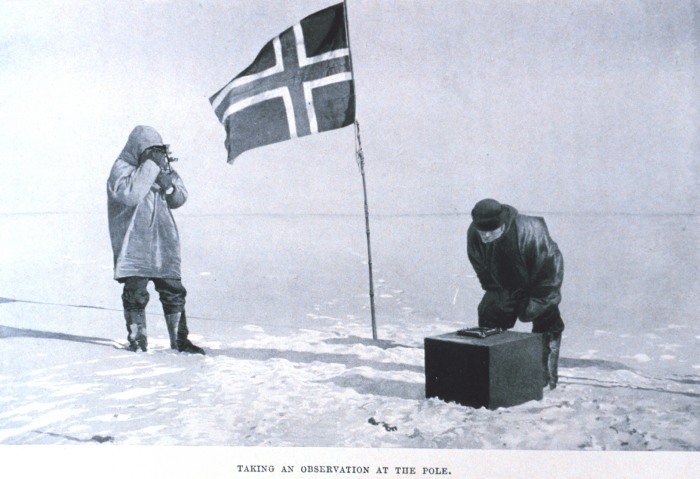
While the skiers erected the encircling markers, Amundsen took altitudes of the sun for fixing his position. Since his theodolite had been damaged, observations were made with a sextant, the sun slowly circling the camp in 24 hours, and never setting.

From these calculations, Amundsen determined that their current position was approximately 5.5 miles from the mathematical South Pole point. This point had been "boxed" by the skiers.

On December 17 Amundsen proceeded to his estimate of the true South Pole position, and took additional observations for 24 hours, two men standing watch for each observation, and co-signing each others navigation books. Again, this was to ensure that there was no doubt as to the expedition attaining the pole. It should be noted that four out of the five men in the polar party were trained navigators.

From these calculations, it was determined that they were still 1.5 miles from the pole, and two men were sent to erect additional pennants.

Finally, Amundsen added still more pennants to cover the remaining area. In this way, the pole had been boxed three times all told.